

Key Takeaways:
- Nearly half of fiscal sponsors don't fully track their true costs, essentially guessing at fees
- Small sponsors (budgets under $10M) report not covering costs 48% of the time
- Sustainable pricing requires calculating both direct costs (staff time, insurance) and hidden costs (overhead, compliance, and technology)
- Three proven approaches work: tiered fees, minimum fees, and hybrid base+percentage structures
- Transparent communication about the "why" behind fee changes builds trust, not resentment
The Real Cost of Undercharging
Here's the uncomfortable truth: if you're a fiscal sponsor charging a flat 5-10% administrative fee that was set arbitrarily, you're probably losing money on every project.
A 2023 field survey found that 46% of fiscal sponsors don't budget or track the full cost of their services. They're not covering their expenses and are essentially subsidizing projects out of their own pocket while hoping it all somehow works out.
The math is brutal. Consider a project with a $100,000 annual budget:
- Direct costs (bookkeeping, insurance, audit share, shared service fees): ~$5,000
- Hidden overhead allocation (ED time, systems, compliance): ~$3,000
- True cost to sponsor: $8,000/year
If you're charging 5% ($5,000), you're losing $3,000 annually on that single project. Scale that across your portfolio, and the deficit compounds fast.
For many sponsors, this isn't sustainable. When they undercharge without incorporating internal efficiencies, teams burn out, quality slips, and outcomes suffer. The field survey referenced earlier found that sponsors with inadequate staffing ratios have less satisfied projects. Undercharging without a cost-reduction strategy means underserving.
The growing exception: Some sponsors have dramatically reduced their cost basis through automation platforms like Mazlo (cutting labor hours by 50-70%), remote/distributed operations (eliminating expensive office overhead), or yield-generating treasury strategies (earning interest on pooled project funds when rates are favorable). These sponsors can sustainably charge lower fees because they've actually reduced costs, rather than simply relying on optimistic assumptions.
→ Need help calculating your true costs? Schedule a consultation
Why Fiscal Sponsors Struggle with Pricing
The "Mission Tax" Mindset
Most nonprofit leaders would rather sacrifice financially than appear profit-driven. It feels noble to keep fees ultra-low, even when it's bleeding your organization dry.
This guilt is reinforced by funders who expect minimal overhead and by the sector's general discomfort with charging for services. Funder pressure has emerged as a key frustration for over a third of sponsors, according to a recent study, alongside other factors influencing overall satisfaction with their fiscal sponsorship relationships. The result? Sponsors essentially tax themselves to benefit their projects.
One-Size-Fits-All Doesn't Fit Anyone
A self-sufficient $500K project might need minimal support. A grassroots $20K startup might require intensive hand-holding. Yet most sponsors charge each the same percentage.
The inevitable outcome: High-maintenance projects get subsidized by low-touch ones, creating hidden cross-subsidies that no one planned for.
The Fear Factor
Perhaps the biggest barrier is fear of pushback. Sponsors worry that raising fees will:
- Drive projects away
- Damage trust and relationships
- Make them look greedy or mission-misaligned
- Trigger complaints even when fees are objectively reasonable
This fear isn't unfounded. Projects have leftover fee disputes. But here's what the data shows: projects are most dissatisfied when sponsors are under-resourced and can't deliver quality service. The very thing they're trying to avoid by keeping fees low.
No Industry Benchmarks
Differences in rates and fees across organizations make it hard for sponsors to know what a fair or typical price is. Some charge 5%, others 15%+. But service bundles vary wildly, making comparisons meaningless. Without clear benchmarks, sponsors feel like they're operating blindly.
What "True Cost" Actually Means
Direct Costs (The Visible Ones)
These scale with project activity:
- Staff Time: 5 hours/month of bookkeeper time at $50/hour = $3,000/year per project
- Project-Specific Insurance: Special event coverage, additional liability riders: $500-2,000/year
- Banking & Transaction Fees: 3% credit card processing on $100K in donations = $3,000 Wire fees, ACH costs, check processing: $200-500
- Audit & Tax Preparation: Your share of 990 complexity, audit sampling: $1,000-2,000 per project
These visible costs alone often amount to $5,000-$ 10,000 annually per moderately active project.
Hidden Costs (The Budget Killers)
These are the expenses that sponsors consistently miss:
Executive Oversight & Compliance: If your ED spends 20% of their time on project-wide policy, legal review, and risk management, that salary portion must be recovered across your portfolio.
Technology Infrastructure: QuickBooks, donation platforms, payroll systems, and grants management software. That $10K annual license? It needs to be allocated per-project, not absorbed as "overhead."
Legal & Liability Coverage: D&O insurance, contract template development, employment law consultation, multi-state compliance. These protect all projects—and cost real money.
Donor Relations & Brand Value: The credibility and trust you've built help projects secure funding. Maintaining that reputation (annual reports, donor stewardship, PR) is a service that projects benefit from but rarely take into consideration.
When you add hidden costs to direct costs, the real support expense often reaches 8-12% of project budgets.
Three Pricing Structures That Actually Work
1. Tiered Fees by Project Size or Complexity
Match your fee to the actual effort required. Example structure:
- Under $50K budget: 12% (higher touch, more intensive per dollar)
- $50K-$250K: 10% (moderate support)
- Over $250K: 8% (economies of scale, self-sufficient)
Why it works: Small projects are genuinely more resource-intensive per dollar. Large projects can absorb more of their own admin. Tiering feels fair to everyone.
Real-world examples: Some sponsors charge different rates for foundation grants versus individual donor funds (reflecting the extra processing work). Others charge lower percentages for donations but higher for government grants (due to compliance oversight requirements).
The challenge: You need clear criteria and solid documentation. Without precise definitions, both sponsors and projects struggle to know which tier applies, leading to confusion, inconsistent treatment, and frustration on both sides.
2. Minimum Fees (The Cost Floor)
Set a baseline that ensures every project covers essential overhead, regardless of size. Example structures:
- "$500 per quarter minimum, or 10% of revenue—whichever is greater"
- "$2,500 annual minimum fee"
- "$100/month minimum platform fee"
Why it works: Ensures every project contributes to the infrastructure that supports them, even when percentage fees alone don't cover basic costs. Fiscal sponsorship is collaborative by nature; many projects need startup support, and most sponsors provide it. What matters is being clear-eyed about when you're subsidizing a project, where those funds come from, and how long you can sustain that support.
In conversations with fiscal sponsors, most agree that percentage-only fees fail for low-revenue projects. And many were exploring the use of minimum fees, with a smaller percentage having already adopted the approach.
The challenge: Tracking and enforcement can be manual and painful, unless you have software that automates monthly minimum calculations. (Shameless plug: Mazlo does this.)
3. Hybrid Structure (Base + Percentage)
Combine a flat monthly/annual fee with a percentage of revenue. Example: $500/month base fee + 5% of all funds raised
The math:
- Small project ($20K/year): $6,000 base + $1,000 (5%) = $7,000 total (~35% effective rate)
- Large project ($500K/year): $6,000 base + $25,000 (5%) = $31,000 total (~6% effective rate)
Why it works: Acknowledges fixed costs exist regardless of project size (base fee), while scaling support costs with activity (percentage). Effective rate tapers down as projects grow, which feels progressive and fair.
You can add caps for very large projects: "base + percentage, maximum $50K annually."
The challenge: More complex to explain and administer. On the explanation side, educate projects on the true cost of nonprofit operations. A $20K project still needs accounting support, legal oversight, grant reporting, and compliance—services that would cost far more than 35% if purchased separately from professional service providers. Beyond the direct costs, there's a hidden burden: the time and expertise required to find these providers, coordinate them, and integrate all the pieces. At a small scale, fiscal sponsorship delivers enterprise-level infrastructure at a fraction of stand-alone costs.
Comparison: Same Projects, Different Cost Structures
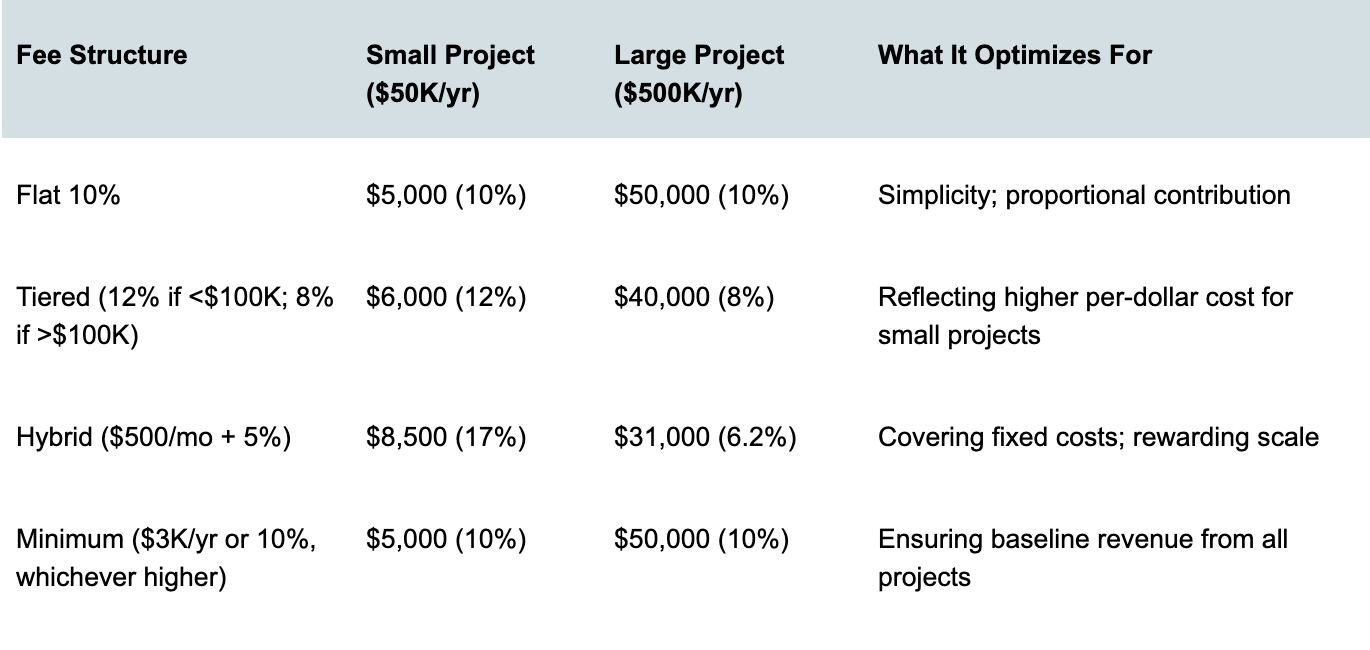
The structure you choose dramatically impacts who pays what. Run the numbers on your actual project portfolio before committing.
How to Talk to Projects About Fee Changes
Raising fees or restructuring pricing is emotionally loaded. But with transparent communication, you can get buy-in rather than backlash.
Lead with Transparency About Costs:
Open your books, conceptually. Show projects what they're actually getting for their fees.
Try this language: "Last year, we spent $X on accounting, insurance, and compliance for sponsored projects. Our current fee structure covered only $Y of that. We've been subsidizing the difference from general operating funds, which isn't sustainable."
When you break down the array of services, from donor support to legal review to technology infrastructure, projects are often genuinely surprised by how much invisible work happens.
Frame it as longevity: "We're making this change so we can continue to be your stable partner for the next 5, 10, 15 years."
Acknowledge the Emotional Reality
Projects run on tight budgets. Fee increases trigger anxiety: "Will our donors accept this? Will we lose funding?"
Don't skip past those feelings. Acknowledge them directly:
"We know any increase in fees is difficult. We're doing this to ensure we can keep providing excellent service without cutting corners or burning out our team, which ultimately protects you and all our projects."
Position it as protecting the community, not just extracting more revenue.
Provide donor-facing talking points. Project leaders need language they can use with their own funders. Give them a script:
"Our fiscal sponsor has adjusted their administrative fee to ensure long-term sustainability. This fee covers critical infrastructure that allows us to focus on program work: accounting and financial oversight, legal compliance, insurance and risk management, donor support and tax compliance, grant reporting systems, and professional guidance. Without fiscal sponsorship, we'd need to hire these services separately at 2-3x the cost—or build our own 501(c)(3), which requires significant overhead and governance capacity we don't currently have. The fee ensures our fiscal sponsor remains a stable, well-resourced partner for years to come."
Emphasize Value, Not Just Transactions
Projects often fixate on visible services (check processing, expense reimbursement, vendor payments) and miss the invisible ones.
Remind them of everything the fee covers:
- Legal and compliance oversight
- Audit preparation and 990 filing
- Insurance and risk management
- Technology systems and security
- Expert advice and troubleshooting
- Brand credibility with funders
Projects are generally most satisfied when sponsors bring expertise and act as true partners. The fee is what enables you to be that partner.
Bonus approach: If you're adding new services with the fee change (HR support, fundraising coaching, better tech tools), lead with those benefits. Turn the conversation from loss to gain.
Offer Transition Options
Avoid surprise shock therapy. Give projects time to adjust.
Transition strategies:
- Phased implementation: "The new structure starts July 1, but we'll phase in increases over two quarters for existing projects."
- Grandfathering: "Current projects keep their existing rate through the end of your current grant cycle."
- Hardship discussions: "If this change creates serious difficulty for your project, let's talk one-on-one about transition suppor.t"
Demonstrating flexibility reduces fear and builds trust.
Put It in Writing (With FAQs)
Follow verbal communication with clear documentation:
Include:
- What's changing and when
- Why it's changing (cost data, sustainability)
- How it affects different project types
- Transition timeline and options
- FAQ addressing predictable concerns
Sample FAQ questions:
- "How did you calculate the new fee?"
- "What if our project budget decreases?"
- "Can donors restrict their gifts from covering fees?" (Answer: No)
Written communication prevents misinformation and gives project leaders something to share with their own boards.
Show Them the Math
For analytically-minded project leaders, a simple cost breakdown can be powerful.
Try a pie chart or one-pager: "Of every dollar collected in fees:
- 60¢ → Direct project support (accounting, compliance, staff time)
- 25¢ → Technology, insurance, and infrastructure
- 15¢ → Organizational sustainability and reserves"
When people see fees aren't being wasted or hoarded, resistance softens.
The field would benefit from better tools to compare costs across sponsors. In the meantime, at least show your internal math: "We've been subsidizing an average of $2,000 per project annually. This change simply brings fees in line with actual costs."
→ Need help with fee conversations? Get expert guidance
When to Make Exceptions (and When to Hold the Line)
Even with a fair fee structure, there are times to bend and times to stay firm.
Valid Reasons for Exceptions
Mission-Critical Subsidies: If a project is deeply aligned with your core mission, you might intentionally charge less as a programmatic investment.
Example: An early-stage advocacy project in your focus area gets charged 5% instead of your standard 10% for its first year. Document this as an "incubation subsidy" and revisit annually.
Use unrestricted funds or create a fee waiver fund specifically for this purpose. Make it a conscious strategic choice, not an accidental pattern.
Crisis and Hardship Relief: When the world goes sideways (pandemic, natural disaster, major grant loss), temporary fee relief can be appropriate.
Example: During the pandemic, many sponsors reduced fees by 50% or waived them entirely for shuttered projects. This was an emergency measure with clear endpoints.
If a project hits a rough patch, consider: "We'll waive fees for three months while you bridge to new funding, with a written agreement to resume at $X date."
Growth-Based Adjustments: A project that started at $50K and now brings in $5M might deserve a volume discount or loyalty consideration.
But be careful: Large projects carry large risks. Make sure you can genuinely afford the discount. Frame it as celebrating their success: "You've grown tremendously under our partnership, here's an adjusted rate for budgets over $2M."
When NOT to Make Exceptions
Consistency is fairness. If you cut special deals for every squeaky wheel, your pricing loses all credibility.
Hold the line when:
- There's no compelling mission or hardship reason
- You'd be setting a precedent that undermines your entire fee structure
- The project can objectively afford it, but doesn't want to pay
- Making an exception would create resentment among other projects
Use data to back yourself up: "I understand the fee feels high, but our analysis shows it costs us $X to support your project. We have to be fair to all projects and sustainable as an organization."
Never make exceptions based on:
- Who's more assertive or demanding
- Personal relationships or favoritism
- Fear of confrontation
Create internal guidelines (even informal ones) for exceptions. Example: "The ED can approve temporary fee reductions for mission alignment or financial distress, not to exceed 6 months without board review."
This keeps exceptions rare, justified, and transparent.
The Bottom Line: Sustainability Through Smart Operations
Cost recovery isn't about profit. It's about aligning your fee structure with your actual cost basis—however you've built it.
Your fees must actually cover your costs. Whether those costs are high (manual operations, in-person infrastructure) or low (automated platforms, distributed teams) doesn't matter—what matters is honest accounting.
Some sponsors achieve sustainable operations at 5-6% through dramatic automation and efficiency gains. Others need 12-15% because they provide high-touch, personalized service with manual processes. Neither is wrong—they're just different operational models with different cost structures.
The key questions:
- What does it actually cost you to support a project?
- Are you covering those costs, or quietly subsidizing from other sources?
- If you've reduced costs through automation or remote operations, have you adjusted fees accordingly?
- If you maintain higher-touch services, do your fees reflect that value?
Additional revenue streams like treasury yield on pooled funds (when interest rates are favorable) can supplement fee income, but they shouldn't mask fundamental cost recovery problems. Know your numbers first, then explore optimization strategies.
Reframe the Narrative
Administrative fees aren't overhead to be minimized. They fund the backbone of impact: financial management, legal compliance, HR support, risk mitigation, and knowledge infrastructure.
These systems allow project leaders to focus on program work instead of drowning in administrative complexity. When you recover your costs fully, you're being responsible—to your staff, your board, and your projects.
Sustainable ≠ Excessive
If you recover 105% of costs and end with a small surplus, that's a cushion for innovation and emergencies. It gets reinvested in better services, technology, training, or potentially lower future fees. The goal is to eliminate chronic deficits, not maximize profit.
Fair Pricing Builds Long-Term Trust
It seems counterintuitive, but charging sustainable fees actually strengthens relationships. Projects want a sponsor who will be there for the long haul, not one that's teetering on insolvency or perpetually understaffed.
Research shows projects report high satisfaction when sponsors deliver on expertise and service quality. That's only possible if you're well-resourced and stable.
The alternative? A sponsor that is one crisis away from shutting down or slashing services. That would devastate projects far more than a few percentage points of fees.
True cost recovery is essential to your mission. By confronting the real numbers and pricing accordingly, you ensure your ability to keep facilitating good work in the world. It's not squeezing projects; it's shoring up the platform they stand on.
Next Steps: Moving from Guesswork to Strategy
You don't have to navigate this alone. Here's your action plan:
1. Calculate Your Actual Costs
Start with the numbers. Build a simple spreadsheet to itemize your direct costs (staff time, insurance, financial fees) and indirect costs (overhead allocation, technology, compliance). Identify where you're subsidizing projects out of unrestricted funds.
Need help building your cost structure? Schedule a consultation to walk through it together.
2. Benchmark Against the Field
Check out the National Network of Fiscal Sponsors 2023 Field Scan for data on what 100+ sponsors charge and recover. See where you fall in the distribution.
3. Test Different Scenarios
Test tiered, minimum, and hybrid structures against your actual project portfolio. Run the numbers to see how each scenario would have performed last year, and what revenue gaps remain.
4. Educate Your Board
Share this post or the NNFS research with your leadership team. Get internal buy-in before rolling out changes. Consider bringing in a peer sponsor who's successfully restructured their fees to speak to your board.
5. Prepare Your Communication
Draft your talking points, FAQ, and transition timeline before announcing changes to projects. Practice the conversation with your team first.
6. Consider Tools That Automate the Hard Parts
Manual tracking of tiered fees, minimums, or hybrid structures is painful. Using Mazlo can automatically calculate and enforce complex fee structures, freeing you from spreadsheet hell.
The automation advantage: Sponsors using powerful automation in Mazlo report cutting their administrative labor by 50-70%, allowing them to sustainably charge lower fees while maintaining quality. When technology handles the busywork (tracking, calculations, compliance enforcement), you can focus on high-value advisory work and reduce your cost basis significantly.
7. Join the Conversation
Connect with peers in the Fiscal Sponsorship Conversations or NNFS Slack. Others have navigated these exact challenges and can offer hard-won wisdom.
→ Schedule a Free Consultation – We'll help you analyze your situation and craft a fee strategy tailored to your mission and project mix.
Every dollar of cost recovered is a dollar that keeps your services strong for the projects and communities depending on you.
Here's to charging what's right—and safeguarding the future of your mission.
Sources
- Social Impact Commons/NNFS Fiscal Sponsor Field Scan 2023
- Zettas, E. "Satisfaction and Dissatisfaction in Nonprofit Fiscal Sponsorship" (2025)
- ProPublica Nonprofit Explorer (Form 990 data)