
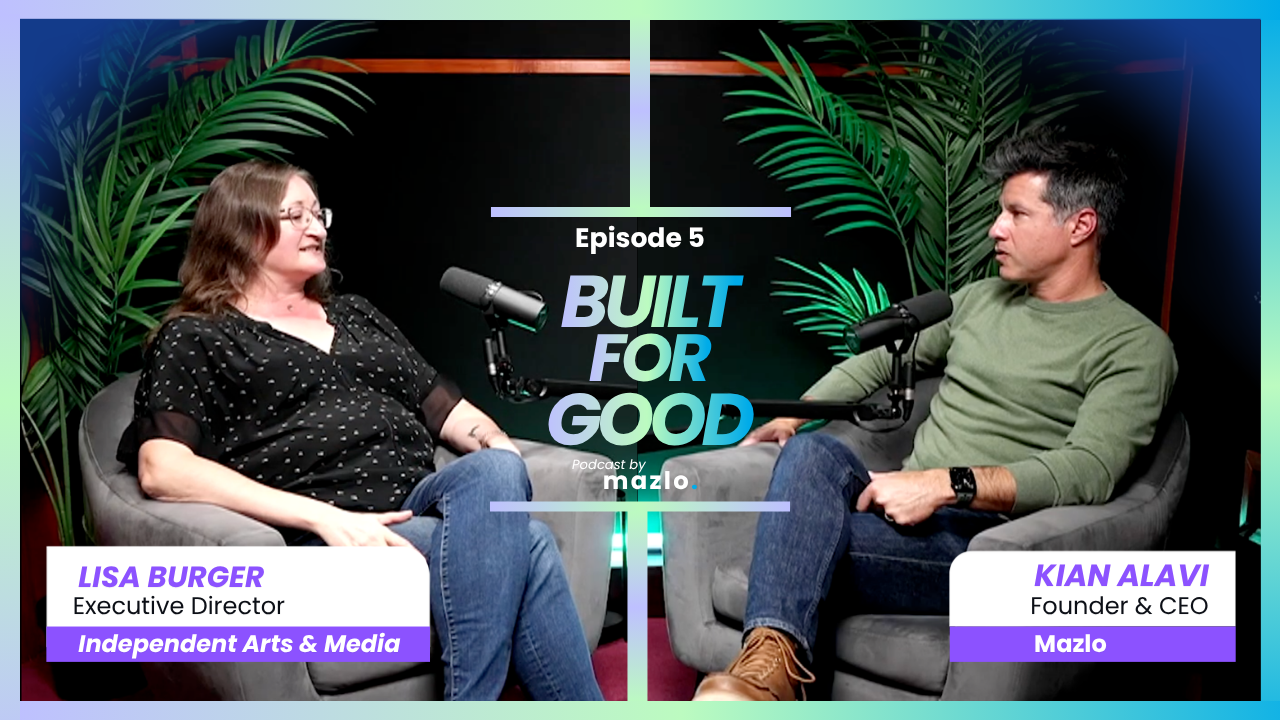
Listen to the full episode on Spotify or Apple Podcasts.
Lisa Burger didn't set out to run a fiscal sponsorship organization. She went to Notre Dame Law School, moved to California for a civil rights fellowship, and spent years at a public interest law firm. She loved the cases, but didn’t love being a lawyer. What she did love was the arts. She was a theater techie in high school and calls herself a fan girl today. After moving to the Bay Area, she got pulled into the industrial arts world and served on the advisory council of the Crucible in Oakland.
She was debating going back to grad school, and a mentor told her to skip grad school and start volunteering instead. She began helping the San Francisco International Women's Film Festival, a project fiscally sponsored by Independent Arts & Media, which Lisa Burger calls “Indie Arts”. Around the same time, Indie Arts invited her onto its board.
That's when everything clicked. Even with a law degree, she had never heard of fiscal sponsorship. Suddenly she saw that people didn't have to start their own nonprofit to do mission-driven work. For artists, who would rather do almost anything than paperwork, that was huge. She became board president within a year. A co-founder essentially handed her the organization. About 10 years later, she's the full-time executive director, and Indie Arts has grown from about 20 projects to about 180 projects.
A Quick Guide to Fiscal Sponsorship Models
Fiscal sponsorship lets a project raise money under an established 501(c)(3). The "model" names come from attorney Greg Colvin, who wrote the book “Fiscal Sponsorship: 6 Ways to Do it Right” on the subject.
Model A (comprehensive fiscal sponsorship)
How it works: The project is legally part of the sponsor. The sponsor holds the insurance, signs the contracts, and is the employer of record for payroll.
Who it fits: Projects with staff, vendors, and complex grants.
Model C+
How it works: The project stays legally separate, but Indie Arts pays its bills from submitted invoices and receipts, acting much like a bookkeeper.
Who it fits: Projects that want help with money management without hiring a bookkeeper.
Model C (pre-approved regranting)
How it works: The project is legally separate. Donations go to the sponsor, which regrants them for approved charitable programming. The project receives a 1099.
Who it fits: Independent artists and even for-profit businesses running a defined public-benefit program.
One warning for Model C projects: the full 1099 amount is reported as income. Anything you can't document as a program expense is taxable. "Don't ask for more than what you need," Lisa states. Keep good records from day one.
Lesson 1: Get Ahead of Your Growth
Lisa's first lesson is to anticipate where your growth needs will be, before they arrive. For Indie Arts, the biggest surprise was HR.
In 2020, California's AB5 law changed who counts as an employee. Many people Indie Arts had paid as independent contractors now had to be W-2 employees, including its own small team. That meant more than signing up for a payroll service. It meant handbooks, documentation, and city, state, and federal employment rules.
Indie Arts had a head start. Its nonprofit law firm had worked with it since its restructuring around 2010. When a California Supreme Court ruling signaled the change, those attorneys warned Lisa early and referred her to an employment lawyer. Indie Arts was sorting out who needed to be W-2 before AB5 even reached the legislature.
"Figure out what you need to be doing early and don't put it off, because those are the things that are going to get you in trouble later."
Help projects understand the real cost of employees
Switching to W-2 adds "fringe": workers' comp, employer payroll taxes, and sometimes health benefits. Fringe varies a lot. When Lisa managed an aerial dance company, its dancers and riggers cost far more in workers' comp than office staff.
Indie Arts built spreadsheets to show projects what a role really costs. Because the employer now pays part of the taxes a contractor paid alone, the hourly rate can sometimes be lower. Projects get real numbers before they make a job offer.
Lesson 2: Know Exactly Whose Money Is Whose
Setting fees is hard. Indie Arts brought in a fiscal sponsorship consultant to compare its fees and services with the field. The result: it was on par and covering its costs. Lisa measures fit by staff capacity rather than time per project, which is nearly impossible to track.
When projects ask for discounts, Indie Arts sometimes agrees, usually for a large single gift or a lower-overhead Model C campaign. But every discount goes to the board as an arm's-length decision.
"We can't just unilaterally give everybody discounts here and there because I like you."
Lesson 3: Relationships Are Where Compliance Happens
Indie Arts tracks expenditures and collects an annual report from every project. But Lisa says the real way she knows what's going on is through relationships. Even a small team should stay in regular contact with its projects. It's also the most fulfilling part of the job.
She learned this the hard way. Years ago, when Indie Arts had less capacity, one project quietly put its own PayPal button on its website. It also pivoted to a new subject without telling anyone and dropped its U.S. base of operations. Over more than a year, it had deposited only about $100 with Indie Arts.
That's a serious problem. Donations made through that button weren't going to a 501(c)(3), so they weren't tax-deductible. When Indie Arts raised the issue, the project leader turned hostile. Indie Arts returned the funds and followed the termination process in its contract and policy manual exactly.
The lessons from that experience:
- Check how projects collect money. Look at the donate buttons on their websites.
- Ask, don't accuse. When something looks off, Lisa reaches out with a simple, "I just want to check in about this."
- Have an exit process in writing. A clear contract protects everyone when a relationship ends.
Building Trust From the First Conversation
Offer many pathways
New projects mostly want to know how to start fundraising. They won't absorb everything at once, and that's fine. Indie Arts shares the same information in many forms: onboarding calls, staff introductions, a member center, a newsletter, a policy manual, workshops like Taxes for Artists, and walkthrough videos. Lisa reminds her staff not to get frustrated. Projects will come back when they need it.
Why Indie Arts sometimes says no
- Mission fit. Indie Arts serves arts and media, so a public health project belongs elsewhere.
- Feasibility. A first-time filmmaker with a seven-figure budget was sent to film-specific sponsors to learn more first.
- Community connection. An applicant wanted to run a community program in Detroit after a two-week vacation, with no ties there. Indie Arts encouraged them to build relationships and support people already doing the work.
Looking ahead: Stability over growth
Lisa is honest that this is a hard moment for arts and media. Many Indie Arts projects serve immigrant, BIPOC, and LGBTQ communities, and its journalism projects feel under threat. Indie Arts isn't built for frontline advocacy, so it focuses on what it can offer: stability. Right now, that means being a safe home for project funds, a source of resources, and a thought partner. It also means meeting regularly with other Bay Area sponsors and arts groups, and speaking up with city, county, and state funders.
What keeps her going is the work itself. Indie Arts' office sits inside Pacific Felt Factory, an artist collective in San Francisco's Mission District. "While I'm a lawyer, I'm a nerd," she says. "I get to hang out with the cool kids." She may never dance on stage, but her skills help make it possible for others to keep doing it. That's the heart of doing it right. Clean books, early planning, and real relationships keep the foundation steady so artists can focus on their art.
Learn more about Independent Arts & Media at artsandmedia.net.
See How Mazlo Helps Fiscal Sponsors Stay Audit-Ready
Mazlo serves as a financial operating system, bringing compliance-driven banking and fund management together across multiple projects. Mazlo can keep each project's funds clearly separated from your general operating funds, enforce compliance with built-in guardrails, and give project leaders real-time visibility into their finances. This allows your team to spend less time managing finances and more time building relationships, all without disrupting the systems you already use.